

A fiery and fatal crash on July 3, 2025, between a pickup truck hauling a trailer and a semi truck parked on the side of the highway closed the westbound lanes of I-70 approaching the Eisenhower Tunnel.
According to the Colorado State Patrol, the preliminary investigation shows that the driver of the Dodge Ram 3000 pickup truck was hauling a trailer itself and traveling westbound in the right lane when it veered onto the shoulder before striking a semi truck, rolling, and catching fire. The crash killed the driver of the Ram; the parked semi truck driver escaped injury.
Officials closed I-70 for hours between Dillon and the Loveland Pass, snarling holiday traffic for most of the day.
While investigators are still determining the cause of the crash, semi trucks parked on the side of the highway can frequently lead to serious crashes. These “sitting duck” crashes often result in catastrophic injuries and fatalities. Federal trucking regulations and many major motor carriers prohibit parking on the shoulder of a highway or other roadway.
Have you been injured in a truck crash or car accident? Call us 303-444-1505
Parking a Semi Truck on the Side of the Roadway Requires Obvious Warnings
Within the trucking and legal community, parked semi truck crashes are known as “sitting duck” crashes. Road shoulders, especially those on highways, are there for emergency use only. It is generally illegal for anyone, including semi trucks, to park on a shoulder in any situation other than an emergency.
State and federal laws generally prohibit all drivers from stopping on the side of a highway or roadway in any circumstances other than an emergency. And this is doubly true for tractor trailer drivers. The Federal Motor Carrier Safety Administration (FMCSA) has established strict regulations outlining the steps truckers must take when they are forced to stop on the side of a roadway in an emergency situation.
Federal regulations require truckers to immediately activate their commercial motor vehicle’s (CMV) hazard warning signal flashers and leave them on until they get additional warning devices in place. Within 10 minutes of stopping on a roadway, a trucker must place warning devices – typically fluorescent reflective triangles – 10 feet, 100 feet, and 200 feet behind the stopped commercial motor vehicle. When a trucker stops on a two-way undivided highway, her/she is also required to place a warning device 100 feet in front of the stopped semi truck.
Commercial truck drivers are trained on the placement of the warning devices from the time they first get their commercial driver’s license (CDL) permit. Colorado’s CDL Manual outlines how the warning devices are to be placed:

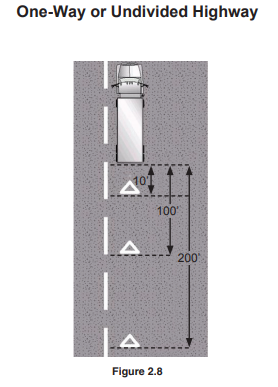
Source: Colorado CDL Manual.
Particularly in the winter, trucks passing over the Colorado mountains will often need to stop to chain up. While this can constitute an emergency condition, truck drivers are still discouraged from stopping randomly on the sides of the road. Instead, officials encourage them to stop in designated emergency parking spots along the mountain corridor. All it takes is proper preparation by the truck driver… and he/she is often given plenty of fair warning by the electronic signs dotting the highway stating “Chain Up” during the winter season. There are more than enough opportunities to do so per the graphic below – without pulling over onto the shoulder.
The Colorado Department of Transportation has issued a special Truck Parking Guide to help truckers navigate I-70 safely. The Truck Parking Guide provides drivers with information on designated emergency parking spaces for semi trucks at various points along the I-70 corridor:

Source: CDOT Truck Parking Guide
Importantly, these spaces are only to be used by truckers to install chains in snow or ice, in weather emergencies, or road closures. CDOT does not intend them to be used in place of rest stops. Officials expect truck drivers to use regular truck stops for rest breaks or to reset hours of service.
“Sitting Duck” Semi Trucks on the Shoulder are Dangerous
It is well known in the trucking industry that crashes involving stopped semi trucks are some of the most dangerous and deadly for drivers. Drivers approaching a stopped semi truck, particularly at night, may not realize it is not moving until it is too late. This can result in a high-speed crash that can be deadly.
In addition to the placement of warning devices on the roadway, semi trucks and, in particular trailers, are required to meet conspicuity requirements with reflective tape. Though simple, conspicuity requirements are extremely important for the safety of the general public.
Particularly at night, semi trucks and their trailers can be difficult or impossible to see on the roadway if they do not have the required reflective materials.
Regulations require truckers to place reflective conspicuity tape along three areas of their trailers. Trailers must have reflective tape running as close as practicable horizontally along the entire length of the trailer. Reflective conspicuity tape must run horizontally along the width of the back of the trailer, as close to the bottom of it as practicable, and also at the upper corners of the back of the trailer.

Source: US DOT
It may sound impossible, but large trailers can virtually disappear at night on unlit roadways. Without the required reflective tape, drivers will not see them until it is too late.
“Sitting Duck” Crashes Are Complex, and You Need an Experienced Truck Crash Lawyer to Help You Navigate Them
If you or someone you love were involved in a “sitting duck” crash with a parked semi truck, you should consult with an experienced truck crash attorney near you.
By now, you should know that regulations only permit semi trucks to park on the side of the roadway in emergencies. Commercial motor vehicles are also subject to strict guidelines for the placement of warning devices and conspicuity requirements. Failure to follow these rules causes crashes.
Experienced truck crash attorneys will start by examining the following issues in a sitting duck crash:
- What was the emergency that required the trucker to stop?
- Were the hazard flashers on?
- Were the warning devices placed within the required time and properly spaced?
- Did the trailer have the required conspicuity tape?
- Was the tape clean and functional?
Understanding and uncovering the circumstances that led a CMV to be parked on the shoulder is only the first step in determining who caused the crash in a sitting duck case.
Despite what defense attorneys and insurance companies would like to believe, the fact that a car crashed into a parked semi truck is in no way dispositive of who was actually at fault for the crash. If the trucker failed to take the required steps, was stopped for a non-emergency reason, like fatigue or hours of service issues, good truck crash lawyers know a strong case can be made that the trucker was the cause of the crash.
You need experienced truck crash attorneys who will know what to look for and how to establish that responsibility rests with the trucker who was parked where they should not have been. Your average car accident or personal injury lawyer will not have the skill or knowledge to recognize the factors in play when a case involves a sitting duck crash.
Sitting duck crashes will often require detailed crash reconstructions by qualified experts. Visibility can be affected not only by the condition of the commercial motor vehicle but also by speed, weather conditions, lighting conditions, the time of day, and the time of year. Reconstruction experts will know that a trailer visible in July might not be visible in February.
Data from the truck itself, its maintenance history, and the driver’s log all can play critical roles in determining whether a parked truck is really at fault in a crash. Ultimately, you need a truck crash lawyer with the skill and experience to understand and interpret this evidence and get you the help you deserve.
Attorneys at the Law Offices of Peter M. Anderson have the experience and education necessary to handle complex truck accident claims. Peter M. Anderson is board-certified in truck accident law by the Academy of Truck Accident Attorneys, one of only two such qualified in the state of Colorado. He can navigate the complex federal regulations applicable to your injury claims. He has a history of successfully holding negligent truck drivers and trucking companies responsible in serious truck crash cases. Call the Law Offices of Peter M. Anderson, Colorado Truck Accident Lawyer at 303-444-1505 today.