

A driver was killed on I-25 south of Denver on September 2, 2025, when a tire came off of a different vehicle heading in the opposite direction. According to the City of Lone Tree, a tire came off of a vehicle travelling northbound on I-25 and struck a car travelling in the southbound lanes, killing the driver.
This fatal Colorado car crash is still under investigation, so we do not yet know what caused such a catastrophic failure. However, wheel separations and tire failures are common causes for car and semi truck crashes.
If a tire failure caused you or a loved one to suffer injuries in a crash, you deserve to know why it happened and if someone could have done something to prevent it. Find the best truck crash attorney near you to help determine the underlying cause of a crash and help you resolve any claim you may have.
Call The Law Offices of Peter M. Anderson, Colorado Truck Accident Lawyer for a free consultation
What Can Cause A Wheel To Come Completely Off a Vehicle
A wheel that completely separated from the vehicle and flew into oncoming traffic appears to have caused this recent fatal crash. What can cause such a catastrophic failure? Generally, with passenger cars, such failures are the result of loose or missing lug nuts.
Any time someone removes or replaces a wheel, they must torque the lug nuts properly to ensure improper installation does not impact safety and performance. The sequence in which you tighten the lug nuts is as important as how tightly you tighten them. Any good mechanic in the United States knows that tightening lug nuts in a clockwise pattern actually leads to some of them becoming loose over time. The following patterns are recommended to ensure that the lug nuts are tightened evenly:
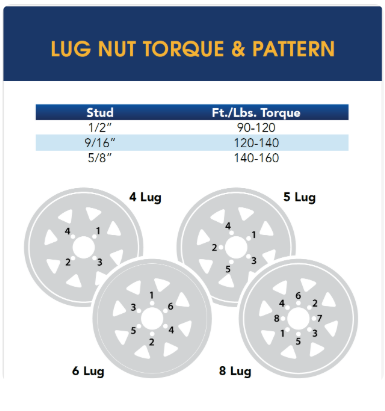
Source: CounterAct
Loose lug nuts can cause vibrations that can ultimately lead to a complete failure causing the wheel to separate from the car or large truck entirely. For this reason, experts need to examine any accident involving a loose or separated tire carefully to determine who bears ultimate responsibility for any injuries or property damage that resulted.
Tire and wheel maintenance is important for any vehicle, but it is especially important when it comes to commercial vehicles. Tire blow out truck accidents or catastrophic wheel failures like the one that killed a driver on I-25 are preventable with proper maintenance.
Federal Regulations Require Semi Truck Drivers to Closely Monitor Tires and Wheels
The best truck accident lawyers know that drivers should catch any problem with wheels or tires on commercial motor vehicles well in advance of any catastrophic failure. Trucking companies have a responsibility to monitor and inspect their fleets.
When they don’t, the hope is law enforcement catches failures during roadside inspections and take the semi truck out of service until the motor carrier corrects the defective condition. When that fails, loose or rogue wheels and tire failures can cause catastrophic crashes even if you are driving a large commercial vehicle yourself.
Source: WTOL11
You need the best wheel failure or tire blow out truck accident attorney to help navigate these complex cases.
Given the size and high speed at which semi trucks travel Colorado highways, and the potential for tire failures to cause a fatal crash, it should not be surprising to learn that the Department of Transportation (DOT) and Federal Motor Carrier Safety Administration (FMCSA) heavily regulate the condition and inspection of semi truck tires.
You can find trucking industry regulations addressing tire condition and safety in section 393.75 of the Federal Motor Carrier Safety Regulations (FMCSRs). Like brakes, a semi truck’s tires experience significant wear and tear during regular daily use. Specifically, the applicable regulations cover:
- Inspections – The FMCSRs require drivers to inspect their tires every day as part of their pre-and-post trip Driver Vehicle Inspection Report (DVIR). This typically requires drivers to visually inspect each tire for wear and check inflation levels, often by “thumping” the tire with a rod. Experienced truck drivers can tell if a tire is sound from the noise it makes when struck.
- Tread Depth – The FMCSRs require all truck and trailer tires to have at least 2/32 of an inch tread depth and 4/32 of an inch on a tractor’s steering tires (the front two tires). When a single tire falls below this level, the driver should pull the tractor or trailer out of service until they can replace the tire.
- Tire Repair – Unlike passenger vehicles, many motor carriers and trucking companies will repair or retread or regroove the tires instead of replacing them. The DOT requires all retreaded tires to meet the same performance standards as new tires. DOT regulations prohibit the use of retreaded tires on the steer tires of buses, but not semi trucks.
- Tire Pressure – The FMCSRs require tire pressure to be within specification for both the tire itself and the specific load being carried. Underinflated tires are just as dangerous as overinflated tires. The DOT recommends that drivers check tire pressure at least once a week. Like passenger cars, many trucks and trailers have active tire pressure monitoring systems (TPMS) that can provide drivers or motor carriers with real time information on tire pressure to ensure safety.
- Inspection of Lug Nuts – The FMCSRs do not specifically regulate how much torque must be used on tractor or trailer tires, relying upon industry standards and equipment specifications. Most industry standards require between 400 and 500 pounds of torque. Drivers must inspect wheels and fasteners in addition to tire tread and inflation.
If a wheel failure caused or contributed to your Colorado truck crash you need experienced truck crash attorneys who will know what to look for and how to prove this was not a freak accident. Your average car accident or personal injury lawyer may not have the skill or knowledge to recognize all the factors and actions that led to wheel or tire failure or the role maintenance or a trucking company can play in tire failure truck crashes.
The Best Truck Crash Attorneys Can Get to the Bottom of Tire and Wheel Issues
The best truck crash lawyers know that poor tire and wheel maintenance can contribute to a truck crash even when it is not as obvious as the failure that led to the fatal wheel separation on I-25. Experienced truck crash attorneys know the clues from the scene or truck inspection that can point to a wheel or tire failure and will know how to find them.
This includes immediately investigating the crash scene so that no one alters or destroys critical evidence. Rain, wind, and other elements can wash away skid marks, debris, and roadway markings. An experienced truck crash attorney or expert can use this evidence to prove that tire condition or maintenance caused the serious truck crash. Properly maintained tires perform differently under stress than poorly maintained ones, and this can often be seen from skid marks or roadway markings.
Insurance companies and defense attorneys try to protect motor carriers and trucking companies by claiming a tire failure was sudden and unexpected. If that actually is the case, you experienced truck crash attorneys will know to look for manufacturing defects in addition to the systemic problems that trucking companies create trying to save time or money which actually lead to these wheel failures. But most tire failures are usually the result of a series of failures over months or years.
Poor or haphazard maintenance programs, putting off tire replacement or wheel inspections, or lazy or skipped daily inspections can, over time, lead to catastrophic failures like the one that caused a wheel to separate on I-25. It takes skill and experience to make sure trucking companies are held liable for preventable crashes.
If you are a victim of a motor vehicle crash that involved a separated wheel or tire, you need a law firm with the experience and education to win tough accident cases. You cannot simply find a car accident attorney near you and expect to get the expertise needed for a complex car or truck crash. Attorneys at the Law Offices of Peter M. Anderson have the experience and education necessary to handle complex truck and car accident claims. Peter M. Anderson is board-certified in truck accident law by the Academy of Truck Accident Attorneys, one of only two such qualified in the state of Colorado. He can navigate the complex federal and/or state regulations applicable to your injury claims. He has a history of successfully holding negligent truck drivers and trucking companies responsible in serious truck crash cases. Call the Law Offices of Peter M. Anderson, Colorado Truck Accident Lawyer, at 303-444-1505 today.